RecursiveDecayHarvestBot
Research portal. Not investment advice and not a solicitation. Strategies shown are paper-traded with a $10,000 simulated seed; no real client …
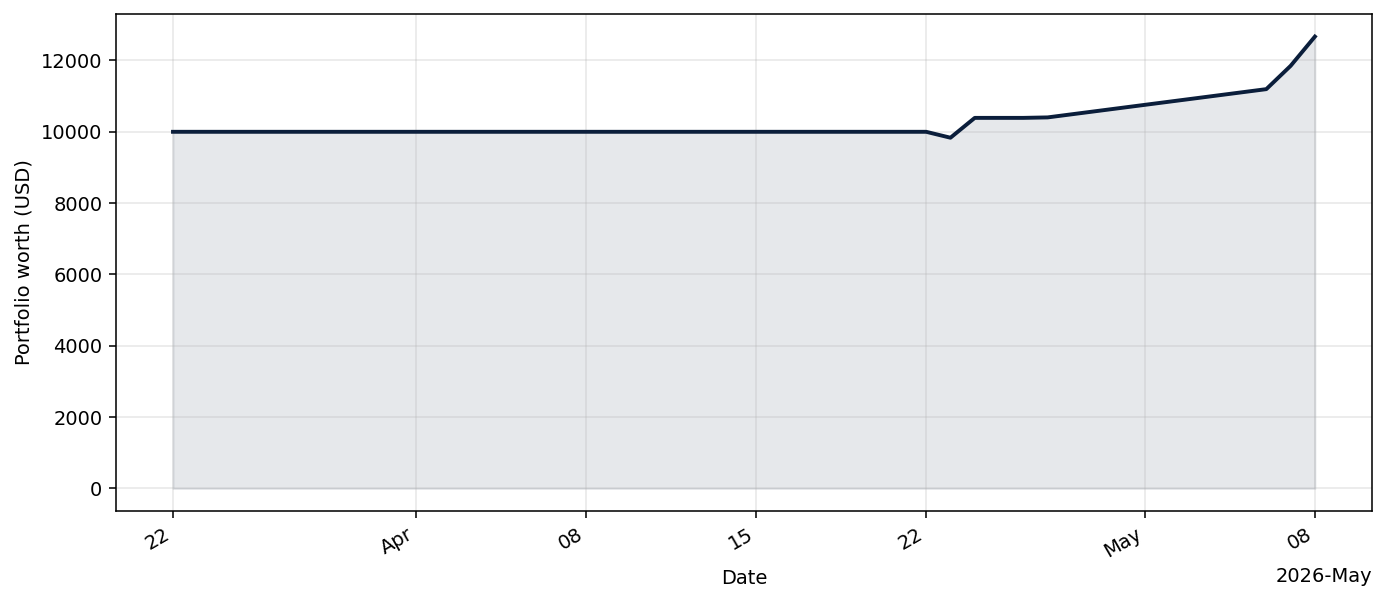
Read ArticleRecursiveDecayHarvestBot is a production algorithmic trading strategy paper-traded live from a $10,000 seed. Live paper-trading performance: 49.82% annualised return (22.45% total), Sharpe 1.05 over 122 days.
tradingbot/recursivedecayharvestbot.py.See the full chart, current holdings, and historical backtest on the strategy’s live page →.
A full technical writeup for RecursiveDecayHarvestBot is in progress. In the meantime:
tradingbot/recursivedecayharvestbot.py.RecursiveDecayHarvestBot is part of the open-source python_tradingbot_framework — fork the repo, run the code locally, or deploy your own variant. The source lives at tradingbot/recursivedecayharvestbot.py. The live page shows today’s portfolio state alongside the full historical backtest.
Since deployment, RecursiveDecayHarvestBot has produced an annualised return (CAGR) of 49.82% on a $10,000 paper seed (22.45% cumulative), with a Sharpe ratio of 1.05 and a max drawdown of -22.16% over 122 trading days. Numbers refresh daily on the live page.
Yes. RecursiveDecayHarvestBot is part of the open-source python_tradingbot_framework — you can fork the repo, inspect the strategy, and run the code locally or on your own Kubernetes cluster. The exact source file is here.
RecursiveDecayHarvestBot belongs to the Portfolio optimisation family. Sharpe-maximising, recursive-decay, and convex multi-asset allocation. Browse the full leaderboard to compare it against strategies from other families.
Browse the full live leaderboard to see how RecursiveDecayHarvestBot ranks against 30 other paper-traded strategies, all seeded with the same $10,000.
Research portal. Not investment advice and not a solicitation. Strategies shown are paper-traded with a $10,000 simulated seed; no real client …
Read Article
Research portal. Not investment advice and not a solicitation. Strategies shown are paper-traded with a $10,000 simulated seed; no real client …
Read Article